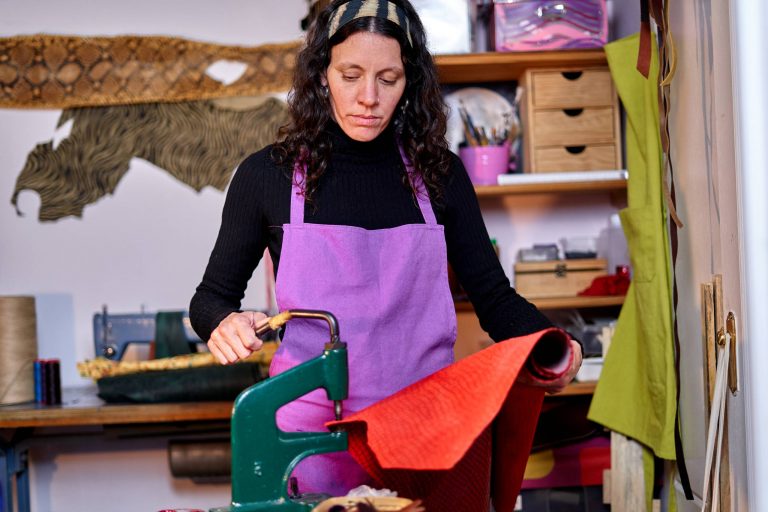
How is depth created in leather embossing? By adding more pressure to the tool? Unfortunately, no. In fact, adding more pressure to the tool is exactly the wrong way to go about creating depth in a piece. Like so many other aspects of leather embossing, creating depth is a matter of structure. Structure within the leather itself, as well as structure in the approach used to build that depth. Properly building depth within an embossing pattern is critical to the look and longevity of the impression, as well as for the overall health of the leather itself. In this article, we will explore the structural elements that contribute to building depth in a leather embossing impression.
Proper casing. As with just about every other tool impression, achieving depth is not just about the pressure with which the tool is struck. Rather, it has to do with the structure of the leather itself. Proper casing is essential for creating a good impression, no matter what depth is desired. The moisture content of the leather determines how easily the leather fibers will move out of the way of the tool, as well as how quickly they will return to their original position. When the leather is properly cased, the impression will be clean and sharp. If the leather is too dry, the leather fibers will not move easily, causing the tool to tear at the leather, rather than making a clean impression. If the leather is too wet, the impressions may collapse or blur as the leather dries. To avoid these issues, make sure that your leather is well-cased before attempting to build depth in your impression. If working on a large project, you may need to re-case the leather periodically throughout the process.
Building in layers. It may be tempting to try to achieve the final depth in a single blow, but this is rarely the best approach. Instead, the best way to build depth in an embossing impression is to work in layers. Make a pass over the area with the tool, striking it firmly enough to achieve some depth. Then repeat the process, perhaps increasing the force with which you strike the tool. Repeat again and again until the desired depth is achieved. This process allows the leather to best absorb the shape of the tool, and avoids cutting or tearing the leather fibers. In addition to preserving the structure of the leather, building in layers also allows for the best retention of fine details in the impression. Because each layer is built upon the last, the details of the impression will not begin to get lost or muddled, as might happen if trying to achieve full depth in a single pass.
Contrast with surrounding areas. Finally, when considering how to add depth to an embossing impression, keep in mind the importance of contrast. One of the hallmarks of a well-executed impression is the contrast between raised and lowered areas. The impression of a line or shape is most pronounced when viewed against a recessed background. Without sufficient contrast, an embossing impression can quickly devolve into a mess of lines and shapes, impossible to decipher or read. Consider how you can use lowered areas to create contrast and make your impression pop.