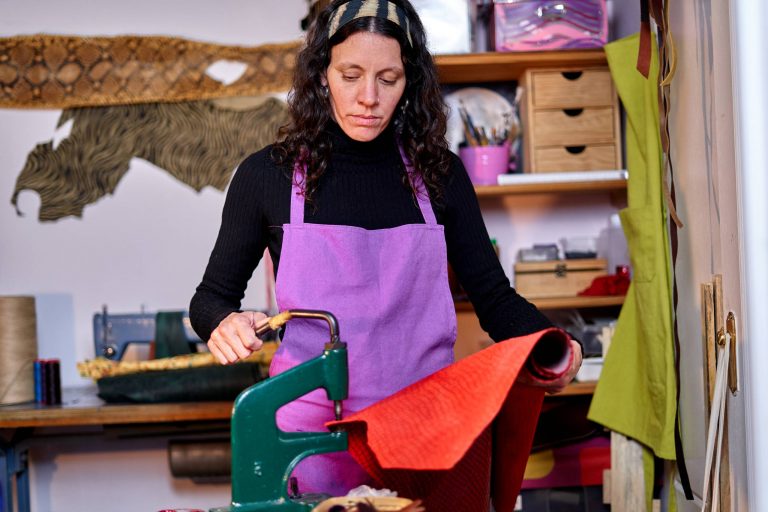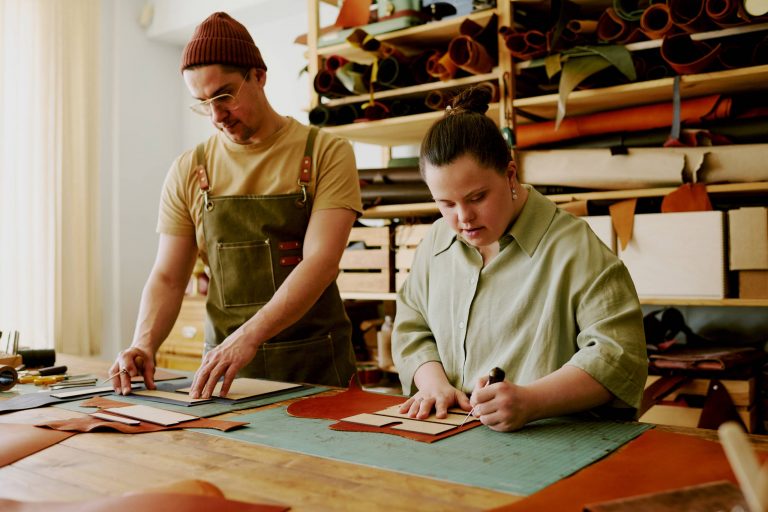
While embossing can be seen as a primarily aesthetic practice, it is fundamentally about pressure, time, and thought. Each mark pressed into the leather is a testament to the moment when the hand determined the amount of pressure, the duration, and the placement. Because it is not applied color or coating, but rather an alteration of the material itself, embossing can be unforgiving. However, it is also rich with opportunity for nuance and expression. This is a practice that demands care and time, but can yield a surface imbued with a sense of rhythm, depth, and organization.
When you first start out, the focus is not so much on intricate designs as it is on learning to work with the leather itself. The amount of moisture it contains, how dense the grain is, the orientation of the fibers, all these things affect the outcome. Leather that’s too dry fights the tool and yields shallow, uneven marks. Leather that’s too wet does not retain clean lines. The ability to gauge these things develops hand in hand with the eye, and eventually becomes second nature.
The development of technique in leather stamping is simply a matter of time and practice. However, the practice should not be simply a blind mechanical hammering away. Every tool strike should be an exploration. Every line and pattern should be a challenge of control. The strikes during the learning process may be irregular, with varying line quality, depth, and even strength of impression. Such irregularities are a good thing as they demonstrate potential flaws in the grip, stance, or tool striking sequence. As the individual learns to slow down and give more importance to evenness rather than just speed, the hand becomes more regular in its movements. The tool becomes an instrument of will rather than an awkward implement to be forced into a particular action.
The main difference between functional embossing and artistic embossing is composition. You don’t just stamp, you compose. You have to think about space and proportion and movement and whether you want the piece to be restful or busy. Even the simplest of designs can have power if they are thoughtfully placed. There are frames to consider, and points of interest, and ways to create unity. And composition is about editing. Everything does not have to be embossed, and every tool does not need to be used. It is just as essential to know when to quit as to know what to do next.
That’s what leather embossing is. A balance of discipline and creativity. Discipline for strength, legibility and manageability. Creativity when discipline no longer requires your attention. Then it becomes art. The leather will tell a story of all the micro-decisions you make with purpose. That’s when embossing isn’t just embellishment. That’s when it’s a craft. When you can hear what the leather is telling you and react to that.